

Ever spot a great-looking HMO deal, hesitate for a day or two while you “run the numbers”… and by the time you call the agent, it’s already under offer?
Or worse, spend most of your free time scrolling rightmove, only to have ‘the one’ under offer before you can even get a viewing?
You’re not alone.
But, we can improve your odds by speeding up the process you’re using and letting it do it’s thing, filtering out properties that won’t work, without getting bogged down on viewings and follow up calls to agents on deals that aren’t right and pull your attention away from the ones that are.
Opportunities are there after all – someone’s buying them!
Most investors get caught in one of three traps:
- Trap one: They feel pressure to offer before they know everything, hoping it all works out.
- Trap two: They overthink everything. Spreadsheet paralysis. DMing every investor they know. Running circles around a deal for a week, until someone else just buys it.
- Trap three: The get side tracked, looking far too deeply into deals that were never good from the get go, and by the time they realise it, theyve missed a good opportunity that was there the whole time.
But the top investors, the ones who move quickly and consistently secure the best Large HMO opportunities in Kent?
They’re using a process.
They don’t rely on gut instinct. They don’t let deals linger. They have a system that tells them, within a matter of hours, whether to go all in or walk away.
That system, we call SCAN.
And if you’re looking for a video to explain it, it’s here:
What is SCAN?
SCAN is a four-part framework we use to eliminate hesitation, double-check our assumptions, and make bold, confident offers, fast.
Or at least, faster than the next person.
SCAN stands for:
- S – Stack the Deal
- C – Check Demand
- A – Attend a Viewing
- N – Negotiate Your Offer
If you’ve already used our SIFT framework to find properties with the right Size, Internal Layout, Frontage, and Town Planning potential, SCAN is what you do next.
This is how you confirm a deal works, crunch the numbers with clarity, and position yourself as the most credible buyer in the agent’s inbox – in an order that protects your time, and gives you the earliest sign that it’s not going to work, before you hop in the car and waste a Saturday that could have been better spent.
Let’s break it down.
Step 1: Stack the Deal – Build Confidence in the Numbers
Deal stacking isn’t about typing numbers into a spreadsheet.
It’s about building a checklist you can trust, that involves picking up the phone and following a process that means by the end, if all lights are green, you’re good to view, and know what to do next. We do this before we view, but after we’ve followed the SIFT process.
Just like a pilot doesn’t take off without their pre-flight routine, an investor shouldn’t make offers without stacking a deal through a structured process that stays the same, regardless of what else is going on, keeping you consistent and thorough every time.
Here’s how we do it (If you’d like to use our spreadsheet and follow along with the video, it’s available in the Kent HMO Alliance here!)
- Use a repeatable template – One tab per deal, consistent structure, green cells for inputs, white cells for outputs.
- Run purchase costs – Include sourcing fees, surveys, legal, stamp duty (automated using a formula like ours so it updates with the purchase price for better accuracy), bridging finance if applicable.
- Calculate income & running costs – Use real rent comps (more on that shortly), and input your management and utility assumptions. £100 per room is a good benchmark for running costs for HMOs.
- Estimate refurb costs – We work off £900/sqm internally and £2,200/sqm for extensions, based on our actual build costs in Kent. If you followed the SIFT process you’ll know if you need to extend to hit the amount of bedrooms you want, and this takes care of estimating those to a very high finish level.
- Include professional fees – Architect, planning, building control—use real quotes where possible. Speak to Architects with HMO schemes that were approved on the planning portal if you need one.
- Work out refinance figures – The big one that builds confidence. Speak to your mortgage broker, get an idea of who the lender might be at the end of your project and ask the broker to find out the local surveyors who are on the approved panel of valuers for that lender. Speak to them, get clarity on their method, establish (if you can) the market yield they use and the cost deductions they apply. Then use a formula in your (or our) sheet to generate a valuation based on this, and your gross rents (more on how to establish rents that coming up)
Fill in the data you know, pick up the phone 3 times to get the rest, and you’re done.
At the end, your deal sheet should show:
- ROI
- Monthly cashflow
- Maximum offer to pull all your money back out
And just like that you’ve removed a lot of the guesswork. You know whether to move forward to a viewing, tweak, or walk.

Step 2: Check Demand for rooms in your price range
No, this isn’t about being close to a train station or the shops. If you’re investing hundreds of thousands of pounds of your (or someone else’s) money, I know you’ll know the value of location for HMO. I’ll assume that’s a given and we can go deeper with that safely in mind.
Most investors grab a few listings from Spareroom and average them out.
That’s not enough.
Rents are the lifeblood of your portfolio, so knowing how to accurately price rooms is a valuable skill to learn, and it’s most valuable before you even view the property.
I’ll explain.
We break this step into two parts:
- Market analysis with real listing data (with an Ai Twist for 2025)
- Cross-check with salary data for your target demographic
Part 1: Pull Spareroom data
- Copy the data from every listing page in Spareroom
- Paste it into ChatGPT and ask it to make you a .csv file
- Input that into Google Sheets
- Filter out all of the ‘live in landlords’ or rooms that are actually 1 bed flats or anything that doesn’t have an ensuite
- Throw this data into a Histogram and a Pie Chart
- Filter the charts into the same £25 slices so we can see how many rooms in each slice across the whole data range and spot a trend.
Now we can see 2 things of importance.
- The Market Centre Price (what most tenants pay, usually the biggest volume)
- The Top of the market range (what the best rooms go for and the comparative size of this share of market).
We want to see cluster of rooms at the top of the market, not just a couple of expensive rooms.
And depending on your refurbishment budget, you can aim either for the market centre, or the top of the market if there’s a healthy amount of rooms at the upper end. (we aim for this as it’s more profitable, even with higher build costs).
But we need to go a bit deeper, and check affordability AND see whether theres an opportunity to have rooms on the market at a higher price than whats listed. And we do that by looking at salary data.
Part 2: Salary-backed affordability
- Use ONS or Nimbus to check local salary data by age and earning percentile.
- Look at as many data sources as you can. Some for the South east to get a broad idea, some in the localised area, and try to find data thats divided into age, as HMO tenants tend to be younger, around 20-35. That’s important.
- Earning percentile, if you’re aiming for the centre of the market, choose the average salary. If you’re aiming for the top of the market, go up to 65th percentile (as anything other than that they can probably afford their own flat)
- Take gross salary, subtract tax, divide by 3, then by 12 = monthly rent + bills budget.
- Check that against your charts in the previous step. If rooms are listed lower, you have a bit of room to try increasing the prices a little and we can test what this looks like in our deal stacking sheet.
Now when you plug in rent into your spreadsheet, it’s not a guess, it’s validated by supply and affordability.
Helps get a bit more confidence in your offer, and it only takes an hour or so every quarter to stay up to date, rather than follow the crowd online… or guess.
If you want to look at some of our data, it’s in the Kent HMO Alliance here.
Step 3: Attend a Viewing – or rather, ‘A Confirmation Viewing’
This is where the pros separate themselves.
You’re not there to “see if you like it.” You’re there to confirm the data you already have. I call these confirmation viewings.
And yes—you bring tools.
Your Viewing Kit:
- Torch with stand – For hands-free loft exploration
- Collapsible ladder – Essential for lofts if you’re planning one
- Laser measurer – Quick, accurate room checks. No tape measurers…they snak in the loft and are annoying.
- Damp meter (optional) – Spot red flags hiding under ‘fresh’ paint
What are you checking?
Take some measurements in the loft to see if you can build an L-Shame dormer (most likely approach to 3 rooms on the second floor) under PD. Measure:
- Loft height up to the ridge, width and depth too of the main loft space.
- If it has an outrigger, you’ll need those same dimensions on there too.
- Garden size and shape, can you extend within PD?
- Width of the rear of the property
- Basement ceiling height, any head height issues?
- Position of manholes, utility meters, staircases — future cost or planning blockers
Here’s the formula I use to see if a proposed L-Shape dormer would be above PD:
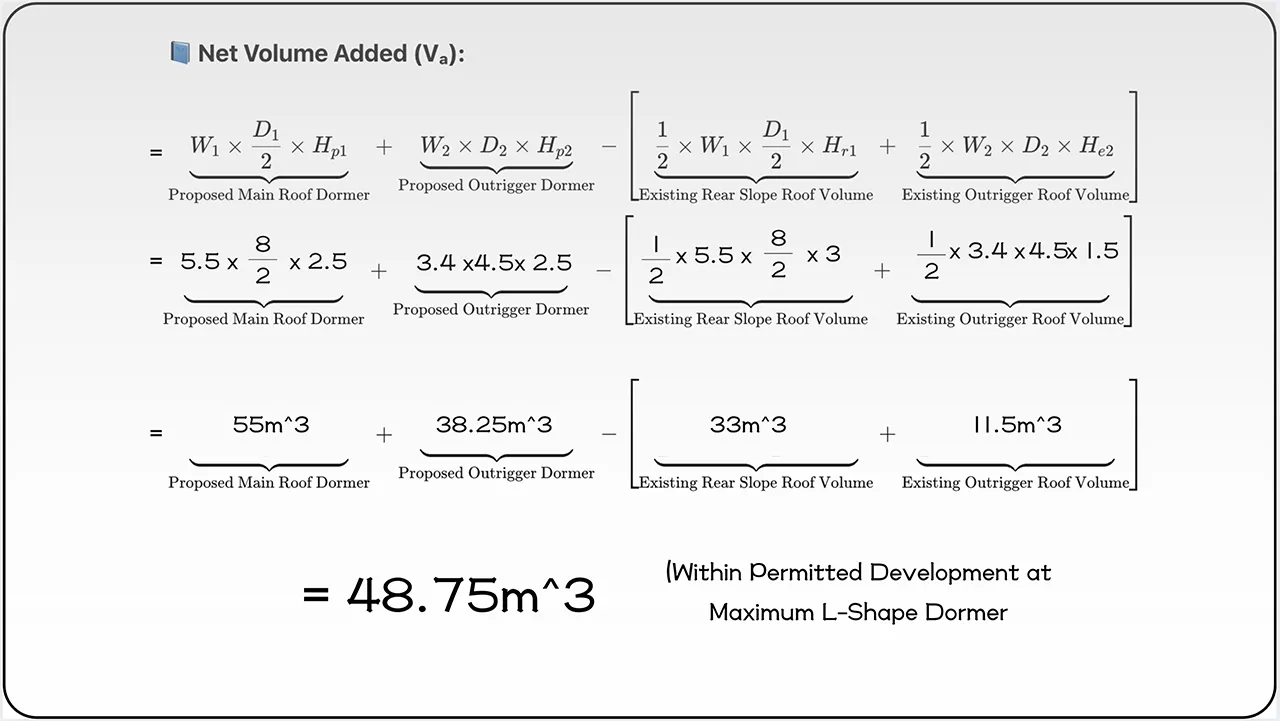
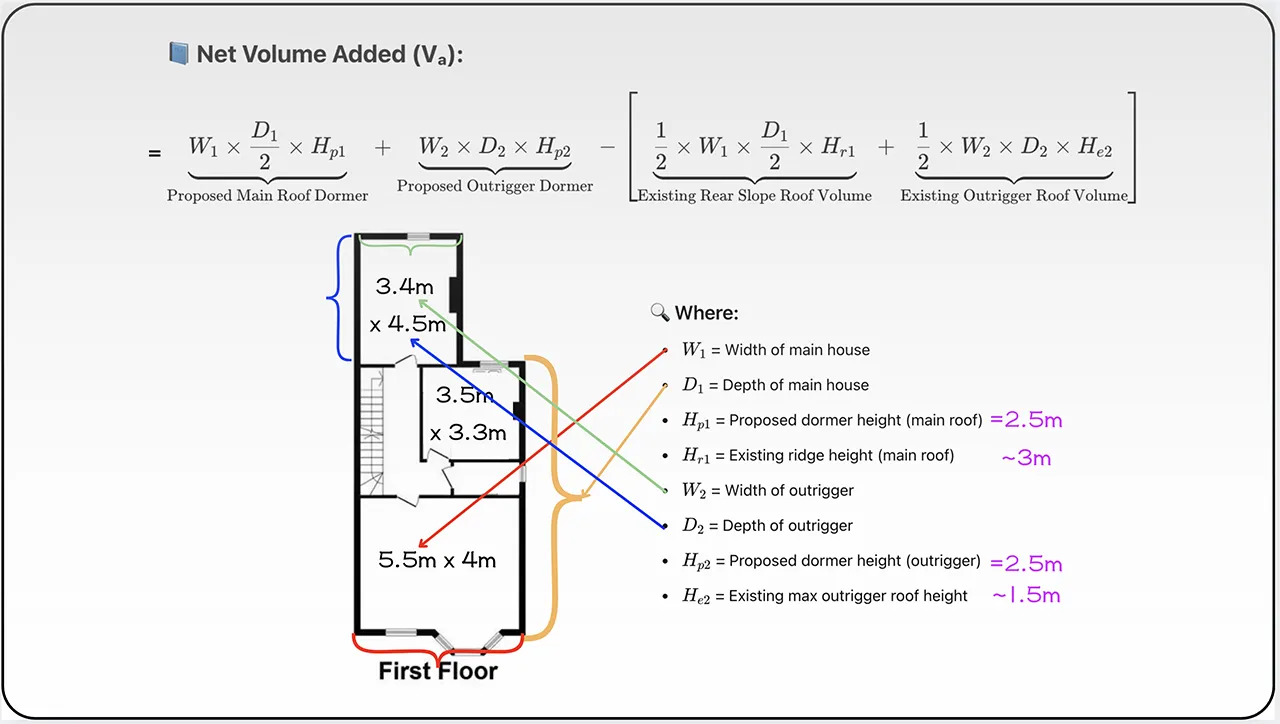
If you’ve watched the SIFT video, you’ll know how to plug these measurements into our loft volume formula to confirm you’re under the 40m³ or 50m³ PD limits.
If it’s a little out, there’s some tips on what to do in the SCAN Video.
This is how you collect the data to back up your stack, and know right there and then whether it’s going to be simple to do, or a pain in the neck.
- Simple = maybe stretch the budget a bit.
- Pain in the neck = be more restrictive on your price and don’t get carried away in a bidding war.
Either way, you’re now in the know, reducing guesswork…and you’re the investor at the viewing with the ladder and the formula to get the answer while they look on with envy.
Step 4: Negotiate Your Offer – The Professional Way
You’ve done all the work. Now don’t blow it with a lazy offer.
Sending a one-line email that says “I’ll offer £399k” doesn’t cut it.
You need to package your offer in a way that makes the agent’s job easier, and builds trust with the vendor.
What to include:
- A letter to the vendor (as a PDF) – Be human. Compliment their property if it deserves one. Outline your offer and how you came to it. Build rapport.
- Proof of funds
- ID and company info
- Solicitor details
- Lender or broker details (if using finance)
Why does this work?
Because agents aren’t just looking for the highest offer, they’re looking for the most certain. The buyer who will complete with the fewest headaches. Ultimately the vendor wants to sell, and it’s the agents job to make that happen.
So, position yourself as the most certain buyer, with everything all ready to go up front and a time limit on your offer (little bonus there) and you’ll be a tempting option for them to recommend to the vendor as a good person to sell to.
You’ll need to submit all of this stuff anyway, so why not use it as a tool to show you mean business and be head and shoulders above the rest…even if your offer isn’t’ the highest.
Make their life easier. They’ll remember it. And even if this deal doesn’t land, you’ll be well placed to be front of mind for the next one.
The Full Picture: SIFT + SCAN = More Confidence, in Less Time
Let’s recap.
The SCAN Framework:
- S – Stack the Deal
- C – Check Demand
- A – Attend a Viewing
- N – Negotiate Your Offer
Combined with the SIFT Framework (Size, Internals, Frontage, Town Planning), this becomes a complete system for finding, confirming, and securing the very best Large HMO deals in Kent.
You’ll move faster. With more confidence. And without the paralysis.
Want to See This in Action?
- Download 4 real case studies of our award-nominated Large HMOs in Kent, complete with floorplans, refurb budgets, rents, and valuations.
- Join the Kent HMO Alliance —our free community where we do monthly deal clinics, answer questions, and give away the exact tools we use in our business to help you too!
Stay sharp. Move fast. And remember:
Investors bring tools. Tourists bring cameras.
To Your Success!
