
The 4-Step ‘SIFT’ Framework
Ever feel like you’re half a step behind the so-called “full-time investors”?
You spot a decent deal… only to find out it’s already gone. No viewing slots left. Offer accepted. Too late… again.
It’s frustrating. And yeah, sometimes it really is just timing. Or a bit of luck.
But, and you’ll be pleased to hear this, often it’s not.
Many times, the reason they’re moving faster is because they’ve filtered out all of the maybes and not wasted time on them and are only going after the best, most likely opportunities, and then going in HARD.
They’re not guessing. They’re not getting stuck in analysis paralysis.
They’ve got a system. A way to instantly filter the wheat from the chaff and when something meets their criteria, they’re ready to act. Fast.
That’s the bit you can control.
What if you could cut out 80% of the listings that hog your attention and lead nowhere and focus 100% of your time on the remaining 20%? Would that make a difference?
What if you could know within seconds whether a property’s worth your energy—or deserves a hard pass?
That’s what this is about.
Over the past three years, we’ve scaled our HMO portfolio across Kent and the South East. We’ve secured four UK Property Investor Award nominations. And we’ve sourced 67 rooms for clients, all using this same process.
It’s a laser focused strategy. And it starts with a framework called SIFT.
In this article, I’ll walk you through the exact 4-step process we use to find, assess, and secure the right large HMO opportunities, before anyone else even knows what they’re looking at.
And if you’re looking for a video rather than a blog, go here:
These ‘full time’ investors are likely doing something you’re not.
AND not-doing something you are.
Let’s dive in.
What is SIFT?
SIFT is our 4-part framework for filtering out bad, borderline, or overworked deals and zeroing in on properties with the highest potential to become well-designed, profitable large HMOs.
SIFT stands for:
- Size
- Internals
- Frontage
- Town Planning
Let’s break each one down and show you how we use it to separate winners from time-bleeders.
Because it’s the time bleeders that will steal your attention, when it’s better focused being first to the opportunity that’s a Grade-A, rather than stacking and viewing properties that ‘might work’.

Step 1: Size – The 5-Metre Rule
When we’re assessing potential HMO properties, the first thing we look at is width.
Forget the price for a second. Forget what the agent says. Forget even the number of bedrooms in the listing.
Ask yourself one question: Does this house physically have the size to function well as a Large HMO?
Here’s why width matters:
- Narrow properties feel tight. Staircases and corridors eat into room sizes. Lofts feel pinched if we extend. Rear extensions feel like corridors. Rooms tend to be oddly shaped once an en-suite is added.
- Wider properties (around 5m+ wall-to-wall) give you room to breathe. Spacious lofts. Better flow. Tenants stay longer. Rent rolls grow.
Think of it like a road trip. You can make it from London to Edinburgh in a hatchback. But it’s not fun. Everyone’s cramped, tired, and counting the minutes. Now imagine a roomy 4×4. Same journey, completely different ride.
That’s what you want for your HMO. A property that’s built to carry the load.
So next time you’re on Rightmove (or an auction listing) skip the photos and scroll to the floorplan. If the width is around 5m or more, you’re onto something.
Dig deeper.

Step 2: Internals – Room Sizes That Actually Work
Once you’ve passed the size check, you’ve earned the right to look inside.
Internals means layout. And layout is everything.
We’re not trying to cram 7-8-9 bedrooms into a 3-bed shell. We’re designing flow. Comfort. Compliance. Value.
Your go-to formula?
- Minimum bedroom size with ensuite: 9m² + 2.5m² for the ensuite
- That’s a 3×3 room, plus a bit extra.
And this is particularly important in the outrigger on the first floor. Too small? It’s not going to work and you’re better off ‘nexting’ it and continuing your search, or picking up the phone to speak to agents and see what’s coming on in the near future. Time better spent in my view.
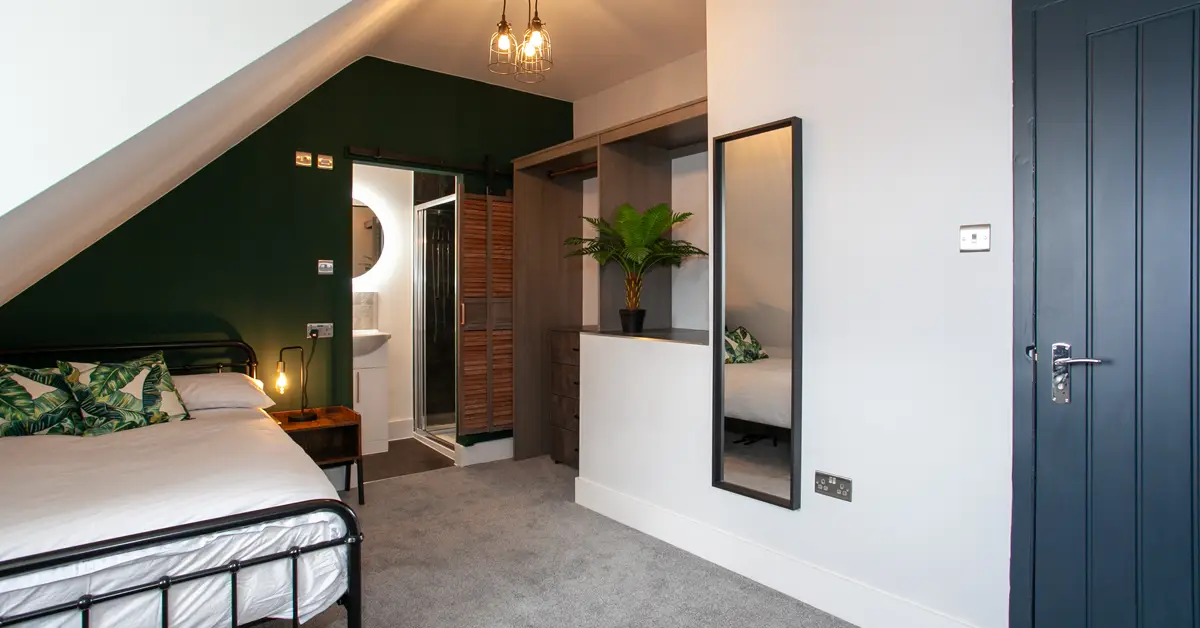
Here’s a sample 9-bed layout we often aim for in Kent, with the building work needed to make it happen:
- 1 in the basement
- 2 on the ground floor
- 3 on the first floor
- 3 in the loft (via L-shape dormer)
Most people overlook the basement. Big mistake. With a bit of clever rejigging, raising the floor above, repositioning stairs, or modest floor drops, you unlock a whole new high-rentable room.
And it’s not just about squeezing rooms in. It’s about making them work. A small, awkward room might technically comply, but it won’t attract the best tenants. And it won’t keep them.
So ignore the price for now. Look at the layout. Can you comfortably fit 7-8–9 good-sized ensuite rooms?
If yes, even if it requires a bigger build, shortlist it. If not: scroll on.

Step 3: Frontage – The Overlooked Deal Killer
You could have a perfect internal layout… and still end up having your sleeve caught in the gears of a planning permission or licensing machine that could eat you up for months.
Why? Because of what’s outside.
If there’s nowhere for the bins, nowhere for the bikes, and no way to escape from the basement room in a fire, your plan will fall apart. Fast.
This is where frontage comes in.
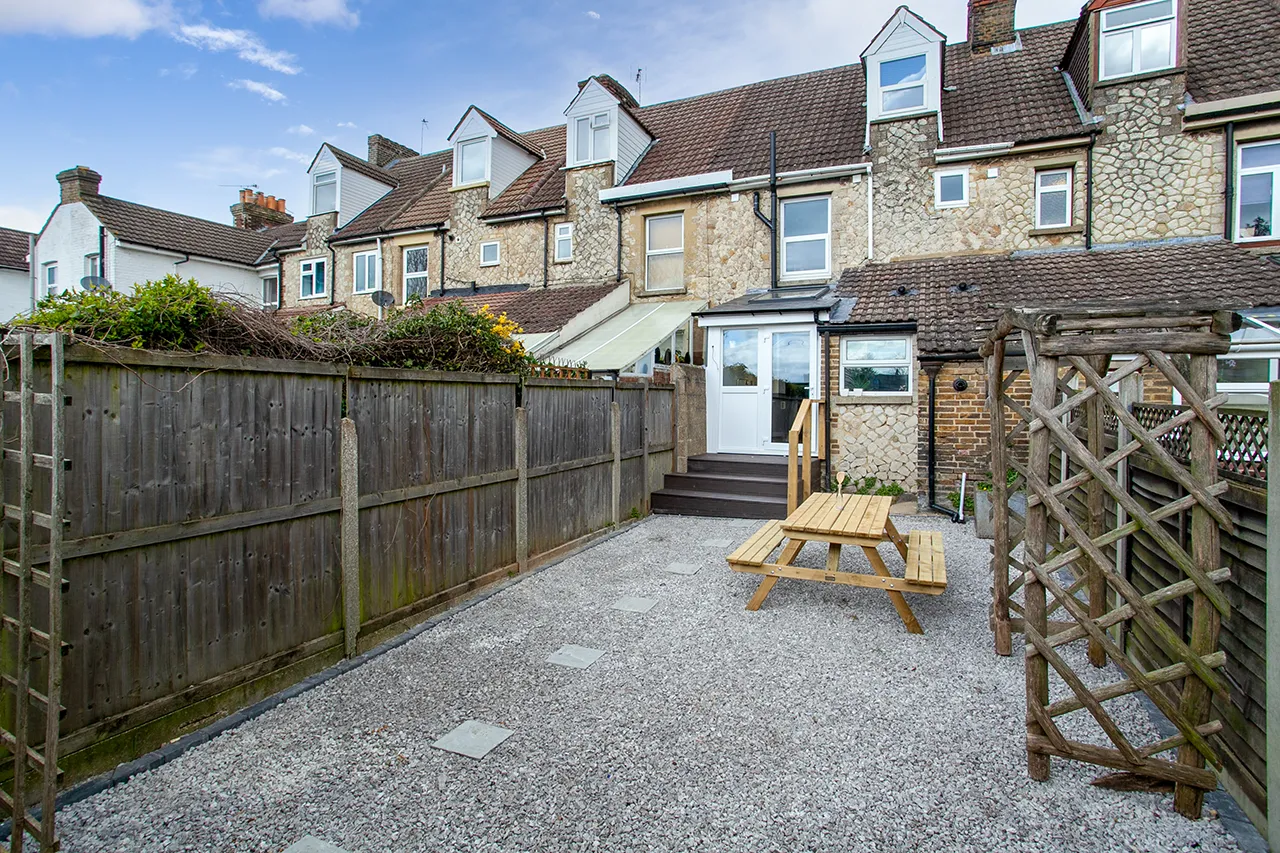
You need space. For bins. For cycle storage. For fire exits. And ideally, for side access, so those things can be tucked around the back instead of clogging the front garden.
Frontage matters to neighbours and town planning, as much as it does to tenants. It’s not a nice to have or an afterthought. It’s a solid reason to scroll past an opportunity, costing you a few moments of ‘looking time’, rather than the hours it will drain from your time-bank in thinking, stacking, viewing, speaking to agents and everything that goes with it.
Get this wrong, and planners will push back. Neighbours will object. And you’ll spend months trying to undo a design that never had space to begin with – particularly painful if you’re thinking it’s refinance time and you can’t get your licence, and even more so if you’re using an expensive bridge.
Step 4: Town Planning – Know Before You Offer
The fourth and final pillar of SIFT is Town Planning. This is where most investors either skip the research, or leave it until it’s too late.
Please don’t do that.
Before we even book a viewing, we ask:
- What is the use class currently and how much friction will there be to change it to Sui Generis?
- Will we need permission for any extensions, and can we get it under Permitted Development (PD)?
Change of Use: C3 → Sui Generis
Most properties you’ll buy are C3 (residential).
If you’re creating a 7-bed+ HMO, you’ll need full planning permission to move it to Sui Generis.
There are no PD rights for this change. So check if the council has approved similar schemes nearby. Use the planning portal. Learn their vibe.
Extensions: Rear + Loft
This is where savvy investors shine.
For single-storey rear extensions:
- Under PD, you can build up to 6m (with neighbour consultation).
- Or 3m without it (or in conservation areas).
- But you can’t take up more than 50% of the garden. So big garden = big opportunity.
For loft conversions:
- Terrace = 40m³ PD allowance
- Semi/Detached = 50m³
You can calculate this yourself, using a simple volume formula (we walk through this more in the video). You’re checking if an L-shaped dormer is doable under PD, or whether you’ll need to apply for full planning, or whether the loft can only get 2 rooms.
Bottom line? Planning should never be an afterthought. It’s how you amplify a great deal, not how you rescue a bad one.
What Happens Next?
Let’s recap the SIFT process:
- Size – Look for width (around 5m+)
- Internals – Prioritise larger properties with spacious layouts with 9m² rooms, particularly in the outrigger
- Frontage – Plan early for bins, bikes, and fire exits (bonus if there’s side access)
- Town Planning – Particular care on the existing loft space, potential for ground floor extension and the size of the garden.
By applying this filter, you’ll notice something: Most of the “deals” you’re seeing online fail on at least one of these points.
And that’s exactly the point. SIFT helps you say “no” faster so you can put more time into finding the properties that will likely work best and say “yes” with confidence.
Only then, will we view.
Otherwise, at least in my view, we’re better off saving our energy and putting that same time into building relationships with agents.
It’s what the ‘full time investors’ are doing isn’t it?
Take back control.
To your success!
Want to Go Deeper? Learn the SCAN Framework Next
SIFT shows you how to spot opportunities. But it’s useless without the second half of the process.
If you want to learn how to stack the numbers, check demand, attend viewings properly, and negotiate with agents, you’ll need our second framework: SCAN.
It’s how we turn great-looking opportunities into profitable, cash-flowing HMOs.
You can watch the full SCAN training video here:
Or level up your investing skills in our FREE HMO community right here.
